
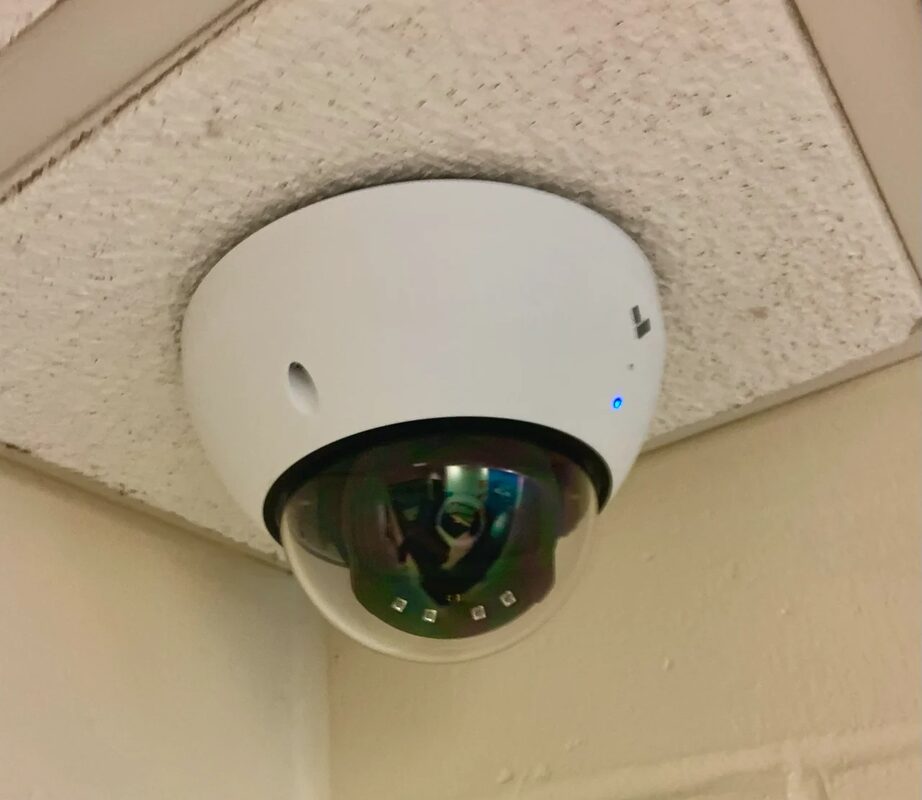
Security camera software usually gets installed once and then forgotten. It runs on a Windows box in a back office and records footage. Often someone has also opened it to the internet so a manager can check the cameras from a phone. A campaign Huntress documented this week shows what that kind of neglect can cost.
In a threat advisory published November 13, Huntress said its security operations center saw malicious activity across 10 customer accounts and 13 organizations. Most of it happened between November 8 and November 10. In every case the activity stemmed from one process: GeoStartupAgentService.exe, a component of GeoVision's camera and video management software. The attackers' goal was not ransomware or data theft. They wanted free computing power, and they installed the XMRig cryptocurrency miner on the hosts they reached.
How the Attack Unfolded
According to Huntress, on many endpoints the GeoVision service ran as NT AUTHORITY\SYSTEM, which is the most privileged account on a Windows machine, and started a command shell. The shell then launched PowerShell, which ran a series of scripts that Huntress labeled simply "a," "b," and "c." Because the parent process was already running as SYSTEM, the attackers' later steps had SYSTEM-level rights from the start.
The scripts first checked whether Microsoft Defender was active. Then the attackers took steps to interfere with it.
- A vulnerable kernel driver. The attackers dropped a driver file named
kvckiller.sys, which Huntress identified as a Windows kernel-mode driver known aswsftprm.sys. Huntress notes this driver has been abused before in "bring your own vulnerable driver" (BYOVD) attacks as a way to tamper with antivirus protections such as Microsoft Defender. In a BYOVD attack, the attacker loads a driver that has a known weakness and uses it to work at the kernel level, where security tools can be shut down. - Hijacked security processes. The attackers configured three Image File Execution Options (IFEO) "Debugger" entries. IFEO is a Windows registry feature that lets administrators configure a debugger to start when a particular executable is launched. In this case, Defender's engine (
MsMpEng.exe), the Windows Security service (SecurityHealthService.exe) and the Windows Security notification-area app (SecurityHealthSystray.exe) were all redirected tosystray.exe. Huntress described this as a likely attempt to keep the intended security processes from starting.
With defenses undermined, a custom loader fetched and ran XMRig. On some machines the loader was set to run every 15 minutes and at system startup.
A Loader Built to Survive Takedowns
The loader is more capable than it needs to be for a simple coin-mining job. Huntress says it includes a BitTorrent Mainline DHT client and a PKARR resolver. Together they let the loader use a public key to find the server's current addresses through peer-to-peer infrastructure, so the operator can move infrastructure without registering a domain or losing access. That makes the operation harder to shut down.
Huntress told Help Net Security it would describe the loader as botnet-like and that its ability to retrieve other payloads could support uses beyond mining, potentially including selling access. It added that it has not seen evidence that access was sold or used for any other purpose in these incidents. The observed payload is XMRig, so for now this is cryptojacking.
Which Vulnerability? Not Confirmed Yet
Huntress's original advisory did not name a CVE or a product version. Two follow-up details from its conversation with Help Net Security narrow things down.
First, exposure. When Huntress looked up victims' external IP addresses on Shodan, a search engine that indexes internet-connected devices, it found publicly exposed GeoVision devices or management interfaces. Second, version. A review of a sample of the affected hosts found GV-VMS 17.4.8.0, a build compiled April 24, 2024. That is older than GeoVision's fixed release, V17.4.8.58.
A Huntress analyst said GeoVision's April 2026 advisory identifies three unauthenticated remote code execution vulnerabilities in the WebCam Server functionality affecting that version, making exploitation of a known flaw the most likely explanation. Huntress was careful to add that it has not determined which of the three CVEs was used, and it has not confirmed whether GeoVision considers these installations supported.
Public vulnerability records show the kind of bug involved. The National Vulnerability Database lists CVE-2026-42370, published May 4, 2026. It describes a stack overflow in the WebCam Server Login functionality of GeoVision GV-VMS V20 20.0.2, where a specially crafted HTTP request from an unauthenticated attacker can lead to arbitrary code execution. NVD shows a secondary CVSS 3.1 base score of 9.0 (Critical) from the CVE's assigning source, and NVD's own primary score is 9.8 (Critical). A related record, CVE-2026-7372, carries a similar description and the same publication date. Those records name GV-VMS V20 20.0.2, not 17.4.8.0, and none of the sources we read ties either one to the three CVEs Huntress mentioned, so it is not established that either is the bug used in this campaign. Treat them as context about the attack surface, not as an attribution.
This is not the first time GeoVision products have been exploited. Help Net Security notes that past in-the-wild exploitation of GeoVision products, such as CVE-2024-6047 and CVE-2024-11120, targeted end-of-life embedded devices. Huntress also says its SOC has seen several previous incidents in which attackers targeted camera systems to carry out malicious activity, and it advises treating camera management software as part of the enterprise attack surface.
What It Means for Defenders
Who is affected: Any organization running GeoVision's Windows-based video management or webcam server software, particularly GV-VMS, on a host reachable from the internet. Huntress's sampled victims ran 17.4.8.0. If your installation is older than V17.4.8.58, treat it as potentially in scope until you confirm otherwise.
Patch or upgrade: The fixed version cited in the reporting is GV-VMS V17.4.8.58. Get there or later. If you cannot confirm the product is still supported, plan a replacement rather than waiting for a fix that may never come.
Remove internet exposure: The WebCam Server flaws Huntress's analyst described are unauthenticated, so exposure to the internet is the attack surface. Huntress advises removing unnecessary public access to GeoVision devices and management interfaces and placing them behind a VPN or restricting access to trusted IP addresses. Check your own external IP addresses the way an attacker would, to see what GeoVision interfaces are visible from outside.
Hunt for the indicators Huntress described:
- Child processes such as
cmd.exeor PowerShell spawned byGeoStartupAgentService.exe. A camera service has little legitimate reason to launch a shell. - IFEO Debugger entries for
MsMpEng.exe,SecurityHealthService.exeorSecurityHealthSystray.exe, especially entries that point tosystray.exe. Any IFEO entry on a security product deserves a close look. - The presence of a
wsftprm.sysorkvckiller.sysdriver. If your EDR or Windows supports a vulnerable-driver blocklist, make sure it is turned on. - Scheduled tasks named
PackageUpdaterorPackageUpdater_Startup, and unexplained CPU load on video management servers, which is the classic sign of a miner.
If you find a compromised host: Huntress advises isolating impacted hosts and preserving evidence before removing files or changing configurations. Because the attackers ran as SYSTEM, loaded a kernel driver and interfered with Defender, cleaning up the miner alone may not restore trust in the machine. Remove the IFEO hijacks, confirm Defender is actually running again, and seriously consider rebuilding the host from known-good media. The loader can retrieve new payloads, so a machine that is only partly cleaned could be told to fetch something else later.
For CMMC and compliance teams: Physical security systems are part of your asset inventory and attack surface. A camera server that nobody owns is an unmanaged, internet-facing Windows box with SYSTEM-level services. Put it on the patch schedule and under monitoring like any other server.
