
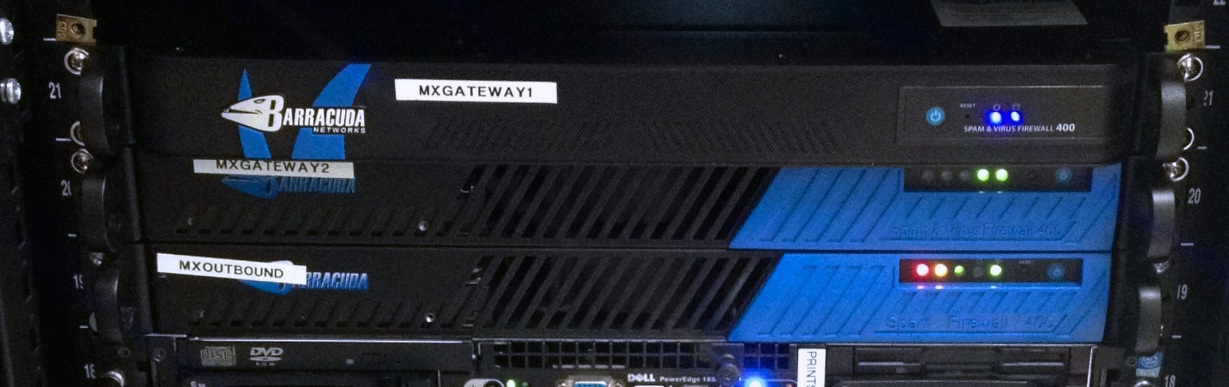
Barracuda has shipped fixes for two vulnerabilities that, used together, let an attacker with no login take full root control of a Barracuda Email Security Gateway (ESG). The patches went out on Monday, November 2. On Thursday, November 5, the security firm watchTowr published a technical analysis of how the two bugs combine. Expect more scrutiny of these appliances now that the analysis is public.
According to The Hacker News, neither flaw appears in CISA's Known Exploited Vulnerabilities (KEV) catalog and no public report ties either to an attack. Still, Barracuda's email gateways have been attacked before, and a published analysis of a pre-authentication path to root gives attackers a roadmap. Patch now. Don't wait for a KEV entry.
Two bugs, one outcome
The two flaws are tracked as CVE-2026-116606 and CVE-2026-111560. Both CVE records were published on November 2 by Mandiant, which acted as the assigning authority. Mandiant also supplied the severity scores. NVD lists both entries as "Awaiting Analysis," so it hasn't added its own scores yet.
CVE-2026-116606 (CVSS 4.0: 9.3, Critical) is an authorization bypass, and it affects only the Email Security Gateway. According to the NVD entry, ESG versions earlier than 9.4.0.030 let an unauthenticated remote attacker reach the appliance's configuration-import function and restore a crafted backup archive. Restoring that archive changes the device's global configuration. Put simply, the feature an administrator uses to load a saved configuration could be used by someone who never logged in.
CVE-2026-111560 (CVSS 8.6) is a command-injection flaw in the timezone configuration field. Command injection means the software passes user-supplied text to the operating system's shell without stripping out special characters. The shell then treats part of that text as a command to run instead of plain data. Per NVD, an authenticated administrator can use this to run operating-system commands as root, the highest privilege level on the box.
Each bug alone has limits. The bypass changes configuration but is not itself a root shell. The injection gives root, but only to someone already signed in as an administrator. The Hacker News reports that on the Email Security Gateway, the bypass supplies that administrator-level access, so chained, the two let an attacker reach root with no login. That is the chain watchTowr documented. watchTowr also released a tool that checks whether an appliance is vulnerable. According to The Hacker News, it has not published an exploit.
Which products are affected
The bypass affects only ESG, but the command injection is broader. Barracuda's advisory lists six product lines affected by CVE-2026-111560, each with its own patch identifier:
- Email Security Gateway: BNSF-40425 for version 9.4.017 and later (as the advisory writes it), BNSF-40430 for older versions. Affected by both CVEs.
- Load Balancer ADC: BNADC-16586
- Message Archiver: BNMA-32468
- WAF Control Center: BNWF-60060
- Web Application Firewall: BNADC-16586
- Web Security Gateway: BNYF-24789
The CVE record for the injection flaw, as served by the NVD API, gives these affected version ranges: ESG up to 9.4.0.27, Load Balancer ADC up to 6.4.0, Web Application Firewall up to 11.0.1, Web Security Gateway up to 16.1.100.100, Message Archiver up to 5.5.4.0 and WAF Control Center up to 2.2.1. For ESG, The Hacker News reports that the problem is fixed in 9.4.0.030 and later.
On the five non-ESG product lines, the injection still needs an administrator account, because the ESG-only bypass isn't there to supply that access. That makes it less urgent than the ESG chain, but not harmless. A stolen or reused admin password, or a malicious insider, would still get root.
The advisory change worth noticing
Barracuda updated its advisory on November 5, the same day watchTowr published its analysis. The "Authentication Required" field for CVE-2026-116606 now reads "No (Administrative UI Access Required)," changed from "Yes, administrative access." That wording carries most of the risk assessment. You don't need credentials to exploit the bug, but you do need network access to the appliance's administrative web interface.
That's how the exposure works in practice. If an ESG's admin interface can only be reached from a trusted internal network, a random attacker on the internet can't start the chain. If the admin interface is open to the internet, or to any broad network segment an attacker might already be inside, the "pre-authentication" label applies in full. Barracuda's advisory says organizations whose administrative interfaces are not publicly accessible from the internet are less exposed to this attack path.
Why ESG gets extra attention
Email gateways sit between an organization's mail servers and the internet, and they process every inbound and outbound message. That position makes them valuable to attackers who want persistent, quiet access. Barracuda's ESG has been hit before. The Hacker News notes that in 2023 a group tracked as UNC4841 exploited a different flaw, CVE-2023-2868, as a zero-day against the Email Security Gateway. That earlier vulnerability is unrelated to the new pair, and nothing ties the new pair to any attacker, but it shows these devices are a proven target.
What It Means for Defenders
Who should act first: anyone running a Barracuda Email Security Gateway, especially if its administrative interface can be reached from the internet or from an untrusted network. That is the setup in which the full unauthenticated-to-root chain applies. Owners of Load Balancer ADC, Message Archiver, WAF Control Center, Web Application Firewall and Web Security Gateway are affected by the command-injection flaw and should patch too.
Patch and verify:
- ESG: confirm the appliance is on 9.4.0.030 or later. Barracuda's patch identifiers are BNSF-40425 (9.4.017 and later) and BNSF-40430 (older versions).
- Load Balancer ADC and Web Application Firewall: BNADC-16586.
- Message Archiver: BNMA-32468.
- WAF Control Center: BNWF-60060.
- Web Security Gateway: BNYF-24789.
- Barracuda recommends that customers who turned off automatic patching set devices to receive patches automatically. If you turned it off for change-control reasons, either turn it back on or apply these patches by hand right away, then check the version on the device rather than assuming the update landed. If a device is multiple firmware versions behind, Barracuda says more than one update may be needed.
Lock down the admin interface: Barracuda recommends restricting administrative interfaces to trusted internal networks and using network access controls to limit exposure. Do this even after patching. The bypass only works for an attacker who can reach the admin UI, and keeping that interface off the internet also limits whatever the next bug turns out to be. Check your firewall rules and any port forwards you've forgotten about, not just the appliance's own settings.
Check for tampering: the bypass works by restoring a crafted configuration backup. On any ESG whose admin interface was reachable before you patched, review the current configuration for changes you didn't make. If something doesn't match, treat the device as possibly compromised. Escalate through your incident-response process and contact Barracuda support rather than simply patching over it. watchTowr's detection tool, which The Hacker News says checks whether an appliance is vulnerable, can help with triage.
Rotate admin credentials where it makes sense: the injection flaw affects six product lines and turns any administrator login into root. Make sure admin accounts on these appliances use strong, unique passwords, and rotate any that are shared or reused elsewhere.
For CMMC and federal contractors: if an email gateway handles Controlled Unclassified Information (CUI), it is worth treating as in scope for your assessment. Recording the patch date, the verified fixed version and the admin-interface restriction aligns with vulnerability-management and access-control evidence.
Neither flaw was on CISA's KEV list as of The Hacker News report, and no attacks had been publicly reported. Use that time to patch and lock down the admin interface, because a public analysis of a chain like this can quickly draw attacker interest.
Sources
- Barracuda advisory: Pre-Authentication Authorization Bypass and Command Injection Vulnerabilities in Certain Barracuda Products
- NVD: CVE-2026-116606 (via mirror of the NVD CVE API; CVE-2026-111560 read the same way)
- The Hacker News: Experts Demonstrate Barracuda Email Security Gateway Chain Enabling Root Access Without Login (Nov 6, 2026)
